


More than seven years have passed since the Grenfell Tower tragedy in June 2017, where 72 people sadly lost their lives after a fire broke out at the 24-storey tower block in West London.
Following the disaster, a public inquiry undertook a comprehensive six-year investigation, examining over 320,000 documents and holding more than 300 public hearings. The final report was published on 4th September 2024 and provided a detailed account of the events and systematic failures that led to the tragedy.
According to the report’s wider findings, over 4,000 residential buildings across the UK, each standing at least 11 metres tall, have been officially identified as having unsafe cladding.
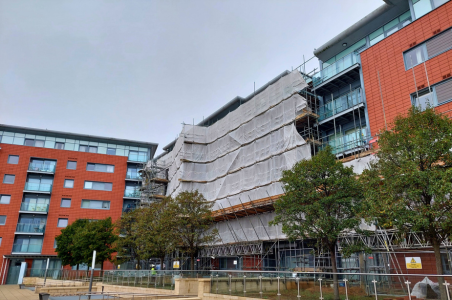
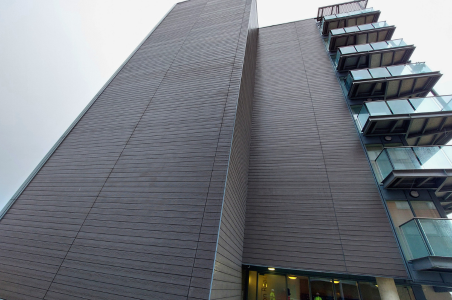
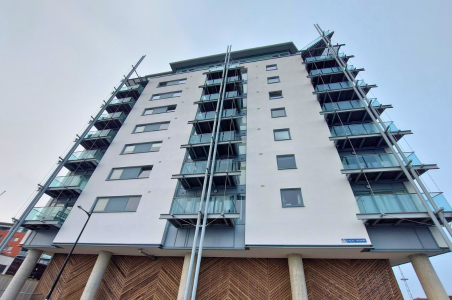
Five such high-rise buildings are situated along the far side of Ipswich’s flagship waterfront, otherwise known as Orwell Quay. The popular apartment blocks are located on Patteson Road, Anchor Street, and Helena Road.
Ingleton Wood provides expert support in fire safety remediation at Orwell Quay
Ingleton Wood was appointed to support the initial Phase 1 and Phase 2 cladding refurbishment projects at Orwell Quay.
Our team has an extensive history of providing expertise and specialist input for property managers and developers involved in remediation work relating to historical fire safety defects, including combustible cladding and defective or missing fire barriers.
Working alongside the managing agents and primary contractor, R G Carter, Ingleton Wood provided project management consultancy support and resident engagement activity for the development.
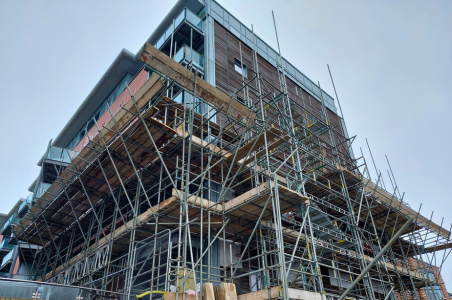
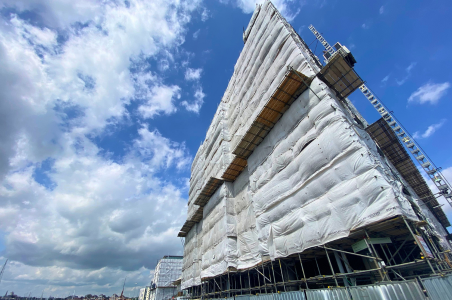
Phase 1 involved two residential blocks comprising 123 properties in total at 51 Patteson Road and 7 Anchor Street. Following in-depth preparations, work on site began in 2022 and was completed on time and to budget in autumn 2023.
Securing vital Building Safety Fund support for Phase 1
Ingleton Wood were thrilled to play a leading role in securing significant funding from the Building Safety Fund (BSF) to support Phase 1.
The two buildings were eligible in part because they were over 18 metres in height, in addition to other criteria. Our expert teams were able to assimilate intricate and specific layers of details to fulfil the necessary requirements.
Effective communication and resident engagement
Phase 1 was widely regarded as a success, receiving positive feedback from the residents’ association, with whom our team worked closely throughout the project.
We ensured consistent communication with residents, facilitating Q&A events to keep stakeholders engaged and informed about the latest developments.
Additionally, we appointed a dedicated tenant liaison officer to provide on-the-ground updates and answer questions from both residents and passers-by.
Communication is critical in sensitive projects such as this. Affected residents want to know what is happening and when, who is responsible for each stage, and need to be consistently reassured that they’re in safe hands with local experts who will get the job done properly.
Therefore, both the quality and speed of communication are paramount, alongside developing warm and trusting relationships with residents, their representatives, and other stakeholders.
Delivering effective communications was one of our highlights of Phase 1, alongside the well-planned, proactive and carefully considered external remediation work itself, which included the installation of EWS A1-rated cladding and rainscreen systems.
Ensuring compliance, resident support, and successful project management
Our team helped to ensure the refurbished buildings were compliant with ever-changing and ever-complex building regulations, and supported early warnings about lead times on subsequent additional materials required after initial investigations.
In addition, we helped to ensure that all residents were able to remain in their apartments throughout the duration of Phases 1 and 2. Sometimes, there is no choice but to involve temporary accommodation. But despite some tight constraints, we managed to avoid this situation.
Meanwhile, for those affected by a lack of balcony access, we helped to oversee the process of removing scaffolding on a stage-by-stage basis rather than one full sweeping removal following completion, which was particularly welcomed by residents.
Building on Phase 1’s momentum
The success of Phase 1 built positive momentum for Phase 2, involving the three remaining Orwell Quay residential buildings (1, 3, and 5 Anchor Street) identified with unsafe cladding. Our teams also provided a similar range of multidisciplinary services for Phase 2. Due to the buildings being under 18 metres in height, they were not eligible to receive BSF funding; however, work on the site commenced and was completed in 2024.
Simon Chesworth, Associate Project Manager, based at our Colchester office, commented:
“We are proud to have played a proactive and important role in the cladding remediation project at Orwell Quay along Ipswich Waterfront and are delighted with the results to date.
Using our expert knowledge of securing funding from the Building Safety Fund and our experience of engaging sensitively and constructively with concerned residents, we have enjoyed working closely with key partners such as R G Carter to successfully deliver Phases 1 and 2, and look forward to replicating the same impact and long-lasting legacies with Phase 3.”


 General Enquiries
 Twitter
 LinkedIn
 Instagram